新書推薦:

《
全球化时代的历史书写:七位欧美历史学家访谈录 尔文智识生活系列
》
售價:NT$
500

《
好能量
》
售價:NT$
454

《
心灵银行手账 : 创造真正改变的卓越系统 世界级催眠大师约翰·卡帕斯博士上世纪90年代收费75万美金
》
售價:NT$
347

《
档案中的虚构:16世纪法国的赦罪故事及故事的讲述者(人类学与新文化史研究经典力作)
》
售價:NT$
347

《
AI社会 : 智能改变世界的十个场景(在这场AI革命中,你是否正在把命运悄悄交给看不见的算法?)
》
售價:NT$
347

《
名侦探的咒缚(东野圭吾:反推理?推理,东野写不下去了吗?这就是答案!一本让人泪流满面的奇幻悬疑)
》
售價:NT$
281

《
亚历山大在世界尽头
》
售價:NT$
408

《
生命的法则(2026年版)
》
售價:NT$
561
|
| 內容簡介: |
|
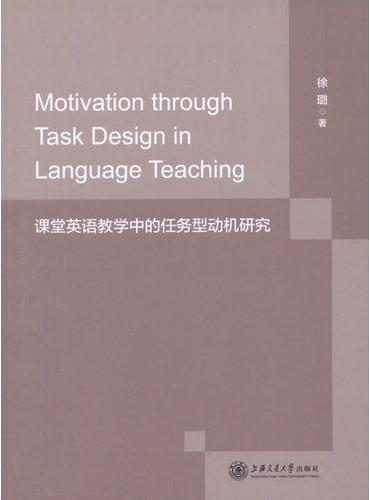
徐璐*作的《课堂英语教学中的任务型动机研究》旨在研究课堂英语教学环境中,如何通过教学任务设计来提高L2学习者的内在任务型动机。该研究采取抽样问卷的定量研究方法,以“任务特征模式”为理论框架,探讨了以下各组变量之间的关系:任务核心特征、L2学习者在参与任务过程中的关键心理状态、任务结果即内在任务型动机,以及L2学习者个人成长需求。该研究为课堂环境中的任务型教学法提供了理论依据,以“任务特征模式”为理论基础,提出了一些具体的教学实践方法,以激发L2学习者的内在任务型动机。
|
| 目錄:
|
Chapter 1 Introduction
1.0 Introduction
1.1 Motivation
1.1.1 Definition of motivation
1.1.2 Classification of motivation
1.1.2.1 Integrative VS.instrumental motivation
1.1.2.2 Intrinsic VS.extrinsic motivation
1.1.2.3 Dornyei''S three-level model
1.1.2.4 Motivation in the classroom
1.2 Tasks
1.2.1 Definition of task
1.2.2 Classification of tasks
1.3 Background of the research:linking motivation and task
1.4 The significance of the research
1.5 The overall structure of the dissertation
Chapter 2 Literature Review
2.0 Introduction
2.1 Studies on motivation
2.1.1 Gardner''S studies on L2 motivation
2.1.1.1 The socio.educational model
2.1.1.2 The AttitudeMotivation Test Battery
2.1.1.3 Comments
2.1.2 Non-SL approach to L2 learning motivation
2.1.2.1 Crookes and Schmidt''S study on L2 learning motivation
2.1.2.2 Oxford and Shearin''S study on L2 learning motivation
2.1.2.3 Comments
2.1.3 Summary:converging divergences
2.1.3.1 The revised socio-educational model
2.1.3.2 Dornyei''S three-level model
2.1.3.3 Conclusion
2.2 Studies on tasks
2.2.1 From the psycholinguistic perspective
2.2.1.1 Long''S interaction hypothesis
2.2.1.2 A‘cognitive approach''to tasks
2.2.1.3 Communicative effectiveness
2.2.2 From the socio-cultural perspective
2.2.2.1 Vygostkian cultural historical psychology
2.2.2.2 Vygotsky-inspired researches
2.2.3 Comments
2.3 Task motivation-linking motivation and task together
2.3.1 Task motivation
2.3.2 Task processing system
2.3.3 Comments
2.4 Summary
Chapter 3 Task Characteristic Model-A Proposed Framework
3.0 Introduction
3.1 Related literature of job enrichment and motivatiol
3.1.1 Early studies on job design
3.1.2 Motivation hygiene theory
3.1.3 Expectancy theory
3.1.4 Activation theory
3.1.5 Socio-technical system theory
3.1.6 Jobs and individual difference:an interactive approach
3.1.7 Summary
3.2 Hackman and Oldham''S studies on job enrichment
3.2.1 The Job Characteristics Model
3.2.2 Hackman and Oldham''S Job Diagnostic Survey
3.3 The rationale of applying the JCM to task design in SLA
3.4 Task Characteristics Model-a proposed framework
3.4.1 Psychological states
3.4.2 Task dimensions
3.4.3 Individual growth need strength
3.4.4 The outcome variable-internal task motivation
3.5 Summary
Chapter 4 Task Diagnostic Survey-An Instrument to Test the Theory
4.0 IntrOduction
4.1 Conceptual basis of the instrument
4.2 Development strategies
4.3 Summary of materials available
4.4 Description of the instrument
4.5 Methodology
4.5.1 Sample
4.5.2 Data collection procedure
4.5.3 Instrumentation
4.5.3.1 Instrumentation for the TDS
4.5.3.2 Instrumentation of the Task Rating Form
4.6 Empirical properties of the TDS
4.6.1 JDS scale reliabilities
4.6.2 Objectivity of the task dimensions
4.6.3 Means and variances of the TDS scales
4.6.4 Relationships among the TDS scales
4.6.5 Summary
4.7 Summary
Chapter 5 Motivation through Task DesignnTest of a Theory
5.0 Introduction
5.1 Purpose of the study
5.2 Research questions
5.3 Analytical methods
5.4 Results
5.4.1 RelatiOnships of the task dimensions and psychological states with the outcomes
5.4.2 Test of the mediating function of the psychological states
5.4.3 Test of the moderating effect of growth need strength
5.5 Discussion
5.5.1 Summary of the findings
5.5.2 Empirical validity of the Task Characteristics Model
5.5.3 MPS as a summary measure of the task characteristics
5.5.4 The nature and effect of growth need strength
5.5.5 Applications of the Task Characteristics Model
5.5.6 Diagnostic use of the TCM and TDS
5.6 Summary
Chapter 6 Conclusion
6.0 Introduction
6.1 Main findings
6.2 Contributions of this study
6.2.1 Theoretical significance
6.2.1.1 Adoption of a new approach
6.2.1.2 Construction of a conceptual framework
6.2.2 Methodological significance
6.2.3 Pedagogical implication
6.2.3.1 A set of action steps-from theory to practice
6.2.3.2 Motivational practices in classroom
6.3 Limitations
6.3.1 From the theoretical perspective
6.3.2 From the methodological perspective
6.4 Recommendations for future research
Appendix A
Appendix B
Appendix C
Appendix D
References
Index
|
|

 購物車/收銀台(0) | 在線留言板
| 付款方式
| 聯絡我們
| 運費計算
| 幫助中心 |
加入書簽
購物車/收銀台(0) | 在線留言板
| 付款方式
| 聯絡我們
| 運費計算
| 幫助中心 |
加入書簽 HOME
HOME 新書上架
新書上架