新書推薦:

《
稳富:悄悄存钱,稳稳变富
》
售價:NT$
296

《
神圣罗马帝国
》
售價:NT$
653

《
优势累积:给中国家庭的松弛父母课
》
售價:NT$
300

《
汗青堂丛书163——狄仁杰与武则天:武周革命与平民官僚的崛起
》
售價:NT$
449

《
历史、神话与艺术:东西方文化的解读和比较
》
售價:NT$
347

《
在别处安家:关于逃离、生存与梦想破碎之地
》
售價:NT$
347

《
棉花王国 密西西比河流域的奴隶制与资本主义 (一部改写美国奴隶制认知的史学佳作)
》
售價:NT$
602

《
历史哲学 一部关于世界文明 理性与历史的终极思考
》
售價:NT$
505
|
| 編輯推薦: |
|
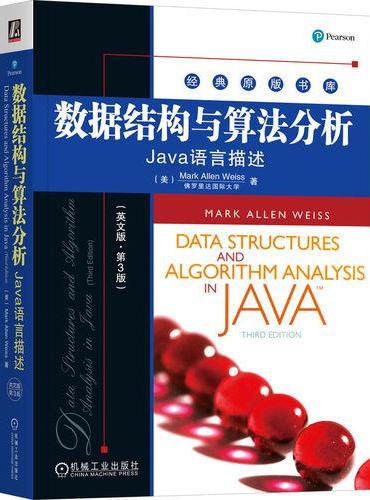
本书是国外数据结构与算法分析方面的经典教材,使用卓越的Java编程语言作为实现工具,讨论数据结构(组织大量数据的方法)和算法分析(对算法运行时间的估计)。
|
| 內容簡介: |
本书是国外数据结构与算法分析方面的经典教材,使用卓越的Java编程语言作为实现工具,讨论数据结构(组织大量数据的方法)和算法分析(对算法运行时间的估计)。
随着计算机速度的不断增加和功能的日益强大,人们对有效编程和算法分析的要求也不断增长。本书将算法分析与最有效率的Java程序的开发有机结合起来,深入分析每种算法,并细致讲解精心构造程序的方法,内容全面,缜密严格。
|
| 關於作者: |
|
Mark Allen Weiss 佛罗里达国际大学计算与信息科学学院教授、副院长,本科教育主任和研究生教育主任。他于1987年获得普林斯顿大学计算机科学博士学位,师从Bob Sedgewick。 他曾经担任全美AP(Advanced Placement)考试计算机学科委员会的主席(2000-2004)。他的主要研究兴趣是数据结构、算法和教育学。 有作者照片
|
| 目錄:
|
Preface v
Chapter 1 Introduction 1
1.1 What’s the Book About 1
1.2 Mathematics Review 2
1.2.1 Exponents 3
1.2.2 Logarithms 3
1.2.3 Series 4
1.2.4 Modular Arithmetic 5
1.2.5 The P Word 6
1.3 A Brief Introduction to Recursion 8
1.4 Implementing Generic Components Pre-Java 5 12
1.4.1 Using Object for Genericity 13
1.4.2 Wrappers for Primitive Types 14
1.4.3 Using Interface Types for Genericity 14
1.4.4 Compatibility of Array Types 16
1.5 Implementing Generic Components Using Java 5 Generics 16
1.5.1 Simple Generic Classes and Interfaces 17
1.5.2 Autoboxing/Unboxing 18
1.5.3 The Diamond Operator 18
1.5.4 Wildcards with Bounds 19
1.5.5 Generic Static Methods 20
1.5.6 Type Bounds 21
1.5.7 Type Erasure 22
1.5.8 Restrictions on Generics 23
1.6 Function Objects 24
Summary 26
Exercises 26
References 28
Chapter 2 Algorithm Analysis 29
2.1 Mathematical Background 29
2.2 Model 32
2.3 What to Analyze 33
2.4 Running Time Calculations 35
2.4.1 A Simple Example 36
2.4.2 General Rules 36
2.4.3 Solutions for the Maximum Subsequence Sum Problem 39
2.4.4 Logarithms in the Running Time 45
2.4.5 A Grain of Salt 49
Summary 49
Exercises 50
References 55
Chapter 3 Lists, Stacks, and Queues 57
3.1 Abstract Data Types (ADTs) 57
3.2 The List ADT 58
3.2.1 Simple Array Implementation of Lists 58
3.2.2 Simple Linked Lists 59
3.3 Lists in the Java Collections API 61
3.3.1 Collection Interface 61
3.3.2 Iterator s 61
3.3.3 The List Interface, ArrayList, and LinkedList 63
3.3.4 Example: Using remove on a LinkedList 65
3.3.5 ListIterators 67
3.4 Implementation of ArrayList 67
3.4.1 The Basic Class 68
3.4.2 The Iterator and Java Nested and Inner Classes 71
3.5 Implementation of LinkedList 75
3.6 The Stack ADT 82
3.6.1 Stack Model 82
3.6.2 Implementation of Stacks 83
3.6.3 Applications 84
3.7 The Queue ADT 92
3.7.1 Queue Model 92
3.7.2 Array Implementation of Queues 92
3.7.3 Applications of Queues 95
Summary 96
Exercises 96
Chapter 4 Trees 101
4.1 Preliminaries 101
4.1.1 Implementation of Trees 102
4.1.2 Tree Traversals with an Application 103
4.2 Binary Trees 107
4.2.1 Implementation 108
4.2.2 An Example: Expression Trees 109
4.3 The Search Tree ADT—Binary Search Trees 112
4.3.1 contains 113
4.3.2 findMin and findMax 115
4.3.3 insert 116
4.3.4 remove 118
4.3.5 Average-Case Analysis 120
4.4 AVL Trees 123
4.4.1 Single Rotation 125
4.4.2 Double Rotation 128
4.5 Splay Trees 137
4.5.1 A Simple Idea (That Does Not Work) 137
4.5.2 Splaying 139
4.6 Tree Traversals (Revisited) 145
4.7 B-Trees 147
4.8 Sets and Maps in the Standard Library 152
4.8.1 Sets 152
4.8.2 Maps 153
4.8.3 Implementation of TreeSet and TreeMap 153
4.8.4 An Example That Uses Several Maps 154
Summary 160
Exercises 160
References 167
Chapter 5 Hashing 171
5.1 General Idea 171
5.2 Hash Function 172
5.3 Separate Chaining 174
5.4 Hash Tables Without Linked Lists 179
5.4.1 Linear Probing 179
5.4.2 Quadratic Probing 181
5.4.3 Double Hashing 183
5.5 Rehashing 188
5.6 Hash Tables in the Standard Library 189
5.7 Hash Tables with Worst-Case O(1) Access 192
5.7.1 Perfect Hashing 193
5.7.2 Cuckoo Hashing 195
5.7.3 Hopscotch Hashing 205
5.8 Universal Hashing 211
5.9 Extendible Hashing 214
Summary 217
Exercises 218
References 222
Chapter 6 Priority Queues (Heaps) 225
6.1 Model 225
6.2 Simple Implementations 226
6.3 Binary Heap 226
6.3.1 Structure Property 227
6.3.2 Heap-Order Property 229
6.3.3 Basic Heap Operations 229
6.3.4 Other Heap Operations 234
6.4 Applications of Priority Queues 238
6.4.1 The Selection Problem 238
6.4.2 Event Simulation 239
6.5 d-Heaps 240
6.6 Leftist Heaps 241
6.6.1 Leftist Heap Property 241
6.6.2 Leftist Heap Operations 242
6.7 Skew Heaps 249
6.8 Binomial Queues 252
6.8.1 Binomial Queue Structure 252
6.8.2 Binomial Queue Operations 253
6.8.3 Implementation of Binomial Queues 256
6.9 Priority Queues in the Standard Library 261
Summary 261
Exercises 263
References 267
Chapter 7 Sorting 271
7.1 Preliminaries 271
7.2 Insertion Sort 272
7.2.1 The Algorithm 272
7.2.2 Analysis of Insertion Sort 272
7.3 A Lower Bound for Simple Sorting Algorithms 273
7.4 Shellsort 274
7.4.1 Worst-Case Analysis of Shellsort 276
7.5 Heapsort 278
7.5.1 Analysis of Heapsort 279
7.6 Mergesort 282
7.6.1 Analysis of Mergesort 284
7.7 Quicksort 288
7.7.1 Picking the Pivot 290
7.7.2 Partitioning Strategy 292
7.7.3 Small Arrays 294
7.7.4 Actual Quicksort Routines 294
7.7.5 Analysis of Quicksort 297
7.7.6 A Linear-Expected-Time Algorithm for Selection 300
7.8 A General Lower Bound for Sorting 302
7.8.1 Decision Trees 302
7.9 Decision-Tree Lower Bounds for Selection Problems 304
7.10 Adversary Lower Bounds 307
7.11 Linear-Time Sorts: Bucket Sort and Radix Sort 310
7.12 External Sorting 315
7.12.1 Why We Need New Algorithms 316
7.12.2 Model for External Sorting 316
7.12.3 The Simple Algorithm 316
7.12.4 Multiway Merge 317
7.12.5 Polyphase Merge 318
7.12.6 Replacement Selection 319
Summary 321
Exercises 321
References 327
Chapter 8 The Disjoint Set Class 331
8.1 Equivalence Relations 331
8.2 The Dynamic Equivalence Problem 332
8.3 Basic Data Structure 333
8.4 Smart Union Algorithms 337
8.5 Path Compression 340
8.6 Worst Case for Union-by-Rank and Path Compression 341
8.6.1 Slowly Growing Functions 342
8.6.2 An Analysis By Recursive Decomposition 343
8.6.3 An O( M log * N ) Bound 350
8.6.4 An O( M α(M, N) ) Bound 350
8.7 An Application 352
Summary 355
Exercises 355
References 357
Chapter 9 Graph Algorithms 359
9.1 Definitions 359
9.1.1 Representation of Graphs 360
9.2 Topological Sort 362
9.3 Shortest-Path Algorithms 366
9.3.1 Unweighted Shortest Paths 367
9.3.2 Dijkstra’s Algorithm 372
9.3.3 Graphs with Negative Edge Costs 380
9.3.4 Acyclic Graphs 380
9.3.5 All-Pairs Shortest Path 384
9.3.6 Shortest-Path Example 384
9.4 Network Flow Problems 386
9.4.1 A Simple Maximum-Flow Algorithm 388
9.5 Minimum Spanning Tree 393
9.5.1 Prim’s Algorithm 394
9.5.2 Kruskal’s Algorithm 397
9.6 Applications of Depth-First Search 399
9.6.1 Undirected Graphs 400
9.6.2 Biconnectivity 402
9.6.3 Euler Circuits 405
9.6.4 Directed Graphs 409
9.6.5 Finding Strong Components 411
9.7 Introduction to NP-Completeness 412
9.7.1 Easy vs. Hard 413
9.7.2 The Class NP 414
9.7.3 NP-Complete Problems 415
Summary 417
Exercises 417
References 425
Chapter 10 Algorithm Design Techniques 429
10.1 Greedy Algorithms 429
10.1.1 A Simple Scheduling Problem 430
10.1.2 Huffman Codes 433
10.1.3 Approximate Bin Packing 439
10.2 Divide and Conquer 448
10.2.1 Running Time of Divide-and-Conquer Algorithms 449
10.2.2 Closest-Points Problem 451
10.2.3 The Selection Problem 455
10.2.4 Theoretical Improvements for Arithmetic Problems 458
10.3 Dynamic Programming 462
10.3.1 Using a Table Instead of Recursion 463
10.3.2 Ordering Matrix Multiplications 466
10.3.3 Optimal Binary Search Tree 469
10.3.4 All-Pairs Shortest Path 472
10.4 Randomized Algorithms 474
10.4.1 Random Number Generators 476
10.4.2 Skip Lists 480
10.4.3 Primality Testing 483
10.5 Backtracking Algorithms 486
10.5.1 The Turnpike Reconstruction Problem 487
10.5.2 Games 490
Summary 499
Exercises 499
References 508
Chapter 11 Amortized Analysis 513
11.1 An Unrelated Puzzle 514
11.2 Binomial Queues 514
11.3 Skew Heaps 519
11.4 Fibonacci Heaps 522
11.4.1 Cutting Nodes in Leftist Heaps 522
11.4.2 Lazy Merging for Binomial Queues 525
11.4.3 The Fibonacci Heap Operations 528
11.4.4 Proof of the Time Bound 529
11.5 Splay Trees 531
Summary 536
Exercises 536
References 538
Chapter 12 Advanced Data Structures and Implementation 541
12.1 Top-Down Splay Trees 541
12.2 Red-Black Trees 549
12.2.1 Bottom-Up Insertion 549
12.2.2 Top-Down Red-Black Trees 551
12.2.3 Top-Down Deletion 556
12.3 Treaps 558
12.4 Suffix Arrays and Suffix Trees 560
12.4.1 Suffix Arrays 561
12.4.2 Suffix Trees 564
12.4.3 Linear-Time Construction of Suffix Arrays and Suffix Trees 567
12.5 k-d Trees 578
12.6 Pairing Heaps 583
Summary 588
Exercises 590
References 594
Index 599
|
| 內容試閱:
|
Purpose/Goals
This new Java edition describes data structures,methods of organizing large amounts of data,and algorithm analysis,the estimation of the running time of algorithms.As computers become faster and faster,the need for programs that can handle large amounts of input becomes more acute.Paradoxically,this requires more careful attention to efficiency,since inefficiencies in programs become most obvious when input sizes are large.By analyzing an algorithm before it is actually coded,students can decide if a particular solution will be feasible.For example,in this text students look at specific problems and see how careful implementations can reduce the time constraint for large amounts of data from centuries to less than a second.Therefore,no algorithm or data structure is presented without an explanation of its running time.In some cases,minute details that affect the running time of the implementation are explored.
Once a solution method is determined,a program must stillbe written.As computers have become more powerful,the problems they must solve have become larger and more complex,requiring development of more intricate programs.The goal of this text is to teach students good programming and algorithm analysis skills simultaneously so that they can develop such programs with the maximum amount of efficiency.
This book is suitable for either an advanced data structures(CS7)course or a first-year graduate course in algorithm analysis.Students should have some knowledge of intermedi- ate programming,including such topics as object-based programming and recursion,and some background in discrete math
Summary of the Most Significant Changes in the Third Edition
The third edition incorporates numerous bug fixes,and many parts of the book have undergone revision to increase the clarity of presentation.In addition,
·Chapter 4 includes implementation of the AVL tree deletion algorithm—a topic often requested by readers.
·Chapter 5 has been extensively revised and enlarged and now contains material on two newer algorithms:cuckoo hashing and hopscotch hashing.Additionally,a new section on universal hashing has been added.
·Chapter 7 now contains material on radix sort,and a new section on lower bound proofs has been added.
vi Preface
·Chapter 8 uses the new union/find analysis by Seidel and Sharir,and shows the O(Ma(M,N))bound instead of the weaker O(Mlog*N)bound in prior editions.
·Chapter 12 adds material on suffix trees and suffix arrays,including the linear-time suffix array construction algorithm by Karkkainen and Sanders(with implementation). The sections covering deterministic skip lists and AA-trees have been removed.
·Throughout the text,the code has been updated to use the diamond operator from Java 7.
Approach
Although the material in this text is largely language independent,programming requires the use of a specific language.As the title implies,we have chosen Java for this book.
Java is often examined in comparison with C++.Java offers many benefits,and pro- grammers often view Java as a safer,more portable,and easier-to-use language than C++. As such,it makes a fine core language for discussing and implementing fundamental data structures.Other important parts of Java,such as threads and its GUI,although important, are not needed in this text and thus are not discussed.
Complete versions of the data structures,in both Java and C++,are available on the Internet.We use similar coding conventions to make the parallels between the two languages more evident.
Overview
Chapter 1 contains review material on discrete math and recursion.I believe the only way to be comfortable with recursion is to see good uses over and over.Therefore,recursion is prevalent in this text,with examples in every chapter except Chapter 5.Chapter 1 also presents material that serves as a review of inheritance in Java.Included is a discussion of Java generics.
Chapter 2 deals with algorithm analysis.This chapter explains asymptotic analysis and its major weaknesses.Many examples are provided,including an in-depth explanation of logarithmic running time.Simple recursive programs are analyzed by intuitively converting them into iterative programs.More complicated divide-and-conquer programs are intro- duced,but some of the analysis(solving recurrence relations)is implicitly delayed until Chapter 7,where it is performed in detail.
Chapter 3 covers lists,stacks,and queues.This chapter has been significantly revised from prior editions.It now includes a discussion of the Collections API ArrayList and LinkedList classes,and it provides implementations of a significant subset of the collections API ArrayList and LinkedList classes.
Chapter 4 covers trees,with an emphasis on search trees,including external search trees(B-trees).The UNIX file system and expression trees are used as examples.AVL trees and splay trees are introduced.More careful treatment of search tree implementation details is found in Chapter 12.Additional coverage of trees,such as file compression and game trees,is deferred until Chapter 10.Data structures for an external medium are considered as the final topic in several chapters.New to this edition is a discussion of the Collections API TreeSet and TreeMap classes,including a significant example that illustrates the use of three separate maps to efficiently solve a problem.
Preface vii
Chapter 5 discusses hash tables,including the classic algorithms such as sepa- rate chaining and linear and quadratic probing,as well as several newer algorithms, namely cuckoo hashing and hopscotch hashing.Universal hashing is also discussed,and extendible hashing is covered at the end of the chapter.
Chapter 6 is about priority queues.Binary heaps are covered,and there is additional material on some of the theoretically interesting implementations of priority queues.The Fibonacci heap is discussed in Chapter ll,and the pairing heap is discussed in Chapter 12.
Chapter 7 covers sorting.It is very specific with respect to coding details and analysis.
All the important general-purpose sorting algorithms are covered and compared.Four algorithms are analyzed in detail:insertion sort,Shellsort,heapsort,and quicksort.New to this edition is radix sort and lower bound proofs for selection-related problems.External sorting is covered at the end of the chapter.
Chapter 8 discusses the disjoint set algorithm with proof of the running time.The anal- ysis is new.This is a short and specific chapter that can be skipped if Kruskals algorithm is not discussed.
Chapter 9 covers graph algorithms.Algorithms on graphs are interesting,not only because they frequently occur in practice,but also because their running time is so heavily dependent on the proper use of data structures.Virtually all the standard algorithms are presented along with appropriate data structures,pseudocode,and analysis of running time.To place these problems in a proper context,a short discussion on complexity theory (including NP-completeness and undecidability)is provided.
Chapter 10 covers algorithm design by examining common problem-solving tech- niques.This chapter is heavily fortified with examples.Pseudocode is used in these later chapters so that the students appreciation of an example algorithm is not obscured by implementation details.
Chapter ll deals with amortized analysis.Three data structures from Chapters 4 and 6 and the Fibonacci heap,introduced in this chapter,are analyzed.
Chapter 12 covers search tree algorithms,the suffix tree and array,the k-d tree,and the pairing heap.This chapter departs from the rest ofthe text by providing complete and careful implementations for the search trees and pairing heap.The material is structured so that the instructor can integrate sections into discussions from other chapters.For exam- ple,the top-down red-black tree in Chapter 12 can be discussed along with AVL trees (in Chapter 4).
Chapters 1-9 provide enough material for most one-semester data structures courses.
If time permits,then Chapter 10 can be covered.A graduate course on algorithm analysis could cover Chapters 7-11.The advanced data structures analyzed in Chapter ll can easily be referred to in the earlier chapters.The discussion of NP-completeness in Chapter 9 is far too brief to be used in such a course.You might find it useful to use an additional work on NP-completeness to augment this text.
Exercises
Exercises,provided at the end of each chapter,match the order in which material is pre- sented.The last exercises may address the chapter as a whole rather than a specific section. Difficult exercises are marked with an asterisk,and more challenging exercises have two asterisks.
viii Preface
References
References are placed at the end of each chapter.Generally the references either are his- torical,representing the original source of the material,or they represent extensions and improvements to the results given in the text.Some references represent solutions to exercises.
Supplements
The following supplements are available to all readers at www.pearsonhighered.com/cssupport:
·Source code for example programs
In addition,the following material is available only to qualified instructors at Pearsons Instructor Resource Center(www.pearsonhighered.com/irc).Visit the IRC or contact your campus Pearson representative for access.
·Solutions to selected exercises
·Figures from the book
Acknowledgments
Many,many people have helped me in the preparation of books in this series.Some are listed in other versions of the book;thanks to all.
As usual,the writing process was made easier by the professionals at Pearson.I‘d like to thank my editor,Michael Hirsch,and production editor,Pat Brown.I’d also like to thank Abinaya Rajendran and her team in Integra Software Services for their fine work putting the final pieces together.My wonderful wife Jill deserves extra special thanks for everything she does.
Finally,Id like to thank the numerous readers who have sent e-mail messages and pointed out errors or inconsistencies in earlier versions.My World Wide Web page www.cis.fiu.edu/~weiss contains updated source code (in Java and C++),an errata list, and a link to submit bug reports.
M.A.W.
Miami,Florida
|
|

 購物車/收銀台(0) | 在線留言板
| 付款方式
| 聯絡我們
| 運費計算
| 幫助中心 |
加入書簽
購物車/收銀台(0) | 在線留言板
| 付款方式
| 聯絡我們
| 運費計算
| 幫助中心 |
加入書簽 HOME
HOME 新書上架
新書上架